|
|
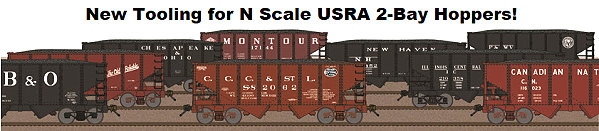
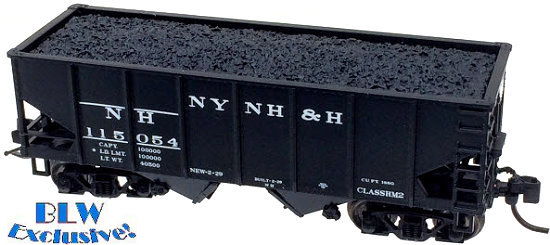
Bluford Shops is proud to announce all-new tooling in N scale for USRA 30’6” 2-Bay Hoppers. More than 55,000 of these cars were built making them one of the most prolific freight car designs of the twentieth century. These ready-to-run cars will feature: diecast slope sheet-hopper bay-center sill assembly; injection molded plastic sides, ends, and hopper doors; fully molded brake tank, valve and air lines; body mounted brake hose detail; coal load; lever-style hand brake; body mounted magnetically operating knuckle couplers; close coupling; and Fox Valley Models metal wheels. All road names will be available in multiple road numbers. For instance, order a single, a 2-pack and a 3-pack to get all six road numbers on a run. (Some road names will be available in just three road numbers.) Pre-orders are now open on the first group of nine road names. Delivery is expected by the second quarter of 2016. MSRP is $23.95 per car.
|
Enter
the quantity of each item that you want to purchase.
Press the ADD button to place it in
your Shopping Cart. |
Description
of Item
Item
Number
 |
Price

|
Qty
to
Order |
Add
Item |
Special
Offer ... only $7.50
Shipping
on new 2 Bay Hopper - 3rd Run due 4th Qtr 2016 |
|
Important
Note: Bluford Shops has announced a 3nd run of their all new 2 Bay Hopper for delivery in 4th quarter of 2016. Your shopping cart will show a "free" zero
deposit reservation. Your card will not be charged
until time of actual shipment. A
separate shipping charge of only $7.50 maximlum will be added
at the time the actual shipment is made. Sorry, but
in stock items cannot be held for advance reservations
to arrive.
Cars
in "orange" field are 3rd batch - scheduled for 4th Qtr 2016 |
|
| N
Scale 30'6" 2 Bay Hoppers - Advance Reservations / 3rd Batch |
Jersey Central Lines had 500 of these USRA hoppers. Obviously identified with the Garden State, CNJ also ran into Pennsylvania where the served the steel making and anthracite mining regions around Allentown, Wilkes-Barre and Scranton. This road name will be available in 6 road numbers.
|
Delaware Lackawanna & Western had 800 of these hoppers. Later in life, they received this paint scheme, complete with “The Road Of Anthracite” square logo. Of the four railroads to have direct routes between the New York City area and Buffalo, Lackawanna was the shortest. This was thanks to some spectacular engineering including the Tunkhannock Viaduct – still the largest reinforced concrete viaduct in the world. This road name will be available in 6 road numbers.
|
Detroit Toledo & Ironton owned 300 of these hoppers. Henry Ford purchased the DT&I as part of a complicated solution to realigning a shipping channel that served Ford’s River Rouge plant. The Ford era (during which these cars were delivered) included clean white overalls and a ban on facial hair for crews. He electrified the line from Carolton to River Rouge, Michigan. Ford era DT&I trains did not run on Sunday. Ford later sold the railroad to a holding company affiliated with the PRR. This road name will be available in 3 road numbers.
|
Litchfield & Madison was a 44 mile railroad linking Madison, Illinois (across the Mississippi River from St. Louis) and Litchfield. They funneled through traffic from Chicago & North Western and Illinois Central to the St. Louis area and loaded coal from large deposits along the line. L&M had 250 of these USRA design hoppers. They were merged into Chicago & North Western in 1958. This road name will be available in 3 road numbers.
|
Minneapolis & St. Louis bought 468 of these USRA hoppers on the used freight car market between 1941 and 1943. This was in response to the opening of large strip mines in northwestern Illinois and southwestern Iowa a few years before. The cars had originally belonged to Chicago By-Products Coke Company and Westmoreland Coal. Chicago & North Western bought the M&St.L in 1960 and merged into their system. This road name will be available in 3 road numbers.
|
Nickel Plate Road acquired this group of 450 USRA hoppers when they merged the Clover Leaf Route (the Toledo St. Louis & Western.) NKP was known for being a high speed bridge line from their western gateways of Chicago, Peoria and St. Louis to their eastern connections at Buffalo. In 1949, their coal traffic expanded massively when they leased the Wheeling & Lake Erie which served large coal deposits in southeastern Ohio.. This road name will be available in 6 road numbers.
|
NPeabody Short Line was launched in 1956 when the Peabody Coal Company purchased the St. Louis & Belleville Electric Railway, a common carrier that linked Peabody’s River King Mine in Freeburg with East St. Louis. The jaunty yellow and green paint followed soon after. While the PSL would ultimately be sold to Illinois Central, Peabody would go on to run 10 more railroads scattered from Kansas City in the west to central Kentucky before the last one was sold in 1993.. This road name will be available in 6 road numbers.
|
The Tennessee Central linked the city of Nashville with the Illinois Central to the northwest and with the Southern Railway to the east, breaking the stranglehold of the L&N and the NC&St.L (which was controlled by L&N) had on rail service to the city. The TC mainline was strewn with 3% grades, big bridges and tight curves. Coal made up a large portion of their originated traffic. In 1968, the TC was divided up between IC, L&N and Southern. This road name will be available in 3 road numbers.
|
The Western Railway of Alabama was a pocket size Class 1 railroad linking Selma and Montgomery, Alabama with West Point just over the Georgia border where they connected with their sister road Atlanta & West Point. The two roads together were referred to as "The West Point Route" and were closely affiliated with the Georgia Railroad. All three were controlled jointly by L&N and Atlantic Coast Line. This road name will be available in 3 road numbers.
|
Data Only USRA 2-Bay Hoppers. These cars are painted black and include dimensional data, builder plates and lubrication data so you can letter them for your own railroad.
|
| N
Scale 30'6" 2 Bay Hoppers - In Stock / Limited! |
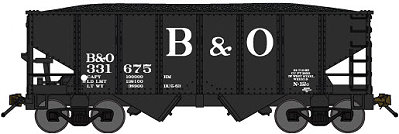
Baltimore & Ohio had over 3,700 of these hoppers many of which would go on to wear this paint scheme adopted by the line in 1955. B&O’s dense network of branchlines in West Virginia fed huge amounts of coal traffic to the system and their connections. This run will be available in six road numbers.
|
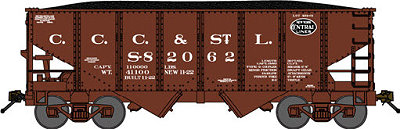
Big Four refers to the Cleveland Cincinnati Chicago & St. Louis Railroad which operated a dense network in Ohio, Indiana, Illinois and Michigan. Vanderbilt and his New York Central controlled the company since its formation and CCC&StL freight cars routinely carried New York Central Lines oval logos. Big Four had 7,250 of these hoppers. This run will be available in six road numbers.anadian National had at least 1,500 of these hoppers that were transferred over from Grand Trunk Railway. In 1957, they began receiving this paint scheme with the 12” billboard name. This run will be available in six road numbers.
|
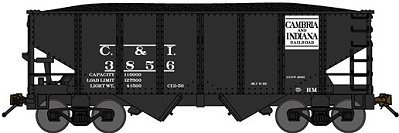
The Cambria & Indiana dates from the 1911 re-naming of the Blacklick & Yellow Creek Railroad serving Cambria and Indiana Counties in Pennsylvania. Originally intended as a lumber hauler, coal quickly took over as the top commodity. C&I began to order far more hopper cars than they could possibly load on their own rails (they had a thousand cars just of this one design as well as thousands of others.) The purpose of the hopper glut was to provide a pool of empties available for other railroads to load and collect the car rental fees. For decades this practice made the C&I the richest railroad per mile of track in the country and made the Cambria & Indiana hopper a common sight around much of the country.
|
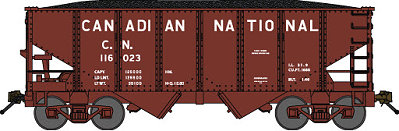
Canadian National had at least 1,500 of these hoppers that were transferred over from Grand Trunk Railway. In 1957, they began receiving this paint scheme with the 12” billboard name. This run will be available in six road numbers.
|
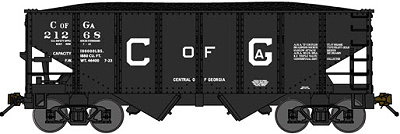
Central of Georgia was an 1,800 mile line blanketing much of Georgia and Alabama. Early in the 20th Century, Illinois Central purchased control of the CoG (the two connected in Birmingham) and managed to hold onto it until the company emerged from receivership in 1948. There followed fifteen years of independence although Frisco made an ill-fated attempt to take control during this period. With Frisco rebuffed, Southern Railway purchased control of the Central of Georgia in 1963. CoG had 300 of these USRA hoppers.
|
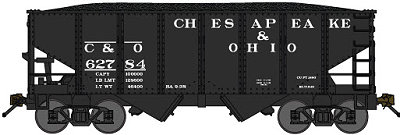
Chesapeake & Ohio received 2,000 of these hoppers in an order split between American Car & Foundry and Pressed Steel Car to help move coal for the war effort. This run will be available in six road numbers.
|
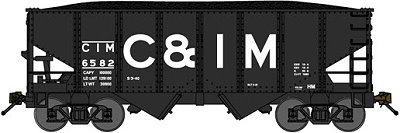
The Chicago & Illinois Midland was a busy, 121 mile coal hauler in Central Illinois. Coal loaded at mines on the line was moved to river docks at Havana, Illinois or to connecting lines including Wabash, B&O, IC, GM&O, C&NW, RI, CB&Q, M&St.L, PRR, TP&W and Nickel Plate. This was a big time operation in a small package. Mile long freights pulled by hansom 2-10-2’s were the norm.
|
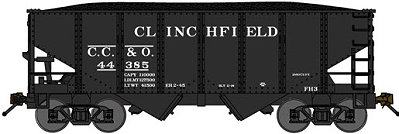
The railroad we know as the Clinchfield was officially called the Carolina Clinchfield & Ohio and used CC&O reporting marks. That is until the property was jointly leased by Louisville & Nashville and Atlantic Coast Line. L&N and ACL established the Clinchfield Railroad (which adopted CRR reporting marks) to operate the property. However, CC&O’s locomotives and rolling stock were included in the lease and continued to wear their original reporting marks even through re-painting. This group of 1,750 USRA hoppers made up the lion’s share of Clinchfield’s hopper fleet for decades. Clinchfield loaded mountains of coal for power plants, ocean piers, factories, mills, and fuel retailers across the east.
|
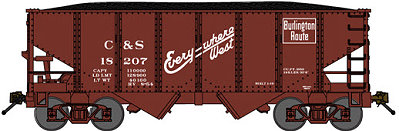
Best known for their narrow gauge operation, the vast majority of the Colorado & Southern consisted of a standard gauge line from connections at Wendover, Wyoming south to Cheyenne, Denver, Pueblo and a connection with their subsidiary Fort Worth & Denver on the Texas-New Mexico border. Together with the FW&D, parent company Chicago Burlington & Quincy and the CB&Q’s parents Great Northern and Northern Pacific, C&S became a vital link between the Pacific Northwest and ports on the Gulf of Mexico. Colorado & Southern took delivery of 300 of these hoppers and was pleased enough with their service that the fleet was rebuilt in parent CB&Q’s Havelock Shops in 1954 to dramatically extend their lives. And that it did. By the spring of 1974, there were still 125 of these cars in operation.
|
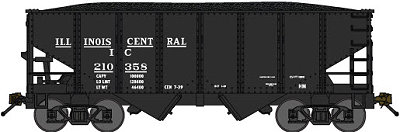
Illinois Central had 1,000 of these hoppers. IC was the largest coal hauler in the immense Illinois Coal Basin which covers much of Illinois, Indiana and western Kentucky providing fuel for much of the nation. This run will be available in six road numbers.
|
|
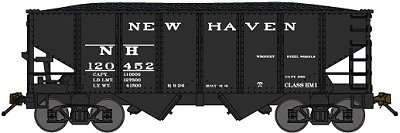
New Haven had 1,500 of these hoppers, more than all other New Haven hopper classes combined. Production was split between four different car builders including Pullman, Pressed Steel Car, Ralston and Standard Steel Car. This run will be available in six road numbers.
|
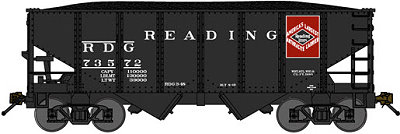
Reading Lines (or Reading Company, the only “Reading Railroad” is on the Monopoly game board) ran 1,150 miles of line, most jammed into the southeast corner of Pennsylvania. One tendril crossed New Jersey to Port Reading on the coast and another tendril hopped the Delaware state line to reach Wilmington. Reading made their fortune mining and hauling clean-burning anthracite coal, quickly becoming “America’s Largest Anthracite Carrier”, a boast they included on their hopper cars. Reading acquired 2,000 of these USRA hoppers for anthracite and bituminous coal traffic..
|
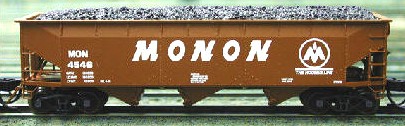
Check out the Bluford Shops 70 Ton Offset 3 Bay Hoppers
Click on the photo below for complete listing.
|
|
|
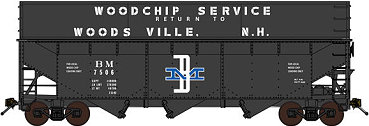
Check out the Bluford Shops Woodchip Service Hoppers
Click on the photo below for complete listing. |
|
| |
|





 Home
Page